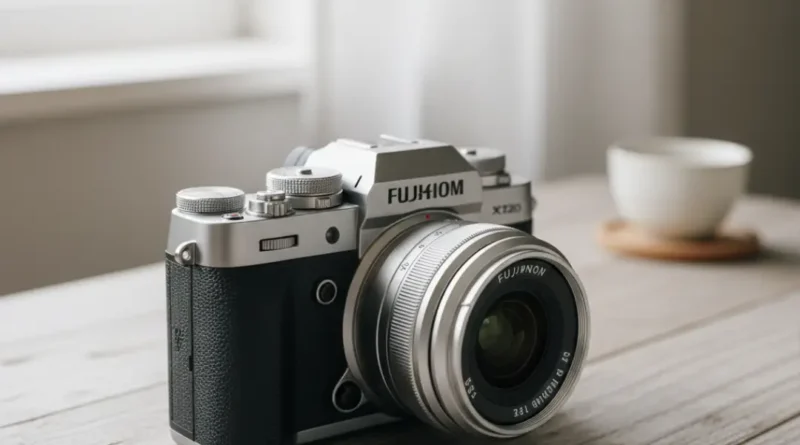
Fujifilm X-T20: A Complete Guide for Everyday Photography
The Fujifilm X-T20 is the camera that reminded me photography can be simple, fun, and still professional. It’s small enough to slip into my bag, yet powerful enough to capture moments I’m proud of. In this guide, I’ll walk you through everything from specs and performance to price and real-world use so you can decide if it’s the right fit for you.
The Story Behind the Fujifilm X-T20
When Fujifilm announced the X-T20 on January 19, 2017, they positioned it as the younger sibling of the X-T2. The goal was clear: give everyday photographers access to pro features without the hefty cost or bulk.
To me, it felt like Fujifilm’s way of saying, “Great photography should be accessible.” And the X-T20 has lived up to that promise.
Compact Design and Handling
The first thing that drew me in was the design. The retro look makes it feel like a classic, but the body weighs just 333 grams light enough to carry all day.
The real joy, though, comes from the dials. Shutter speed, exposure, and drive mode are all at your fingertips. I love being able to twist a dial and keep shooting instead of diving into menus. It makes the process fast, simple, and honestly, fun.

Fujifilm X-T20 Specs and Image Quality
On paper, the Fujifilm X-T20 specs include a 24.3MP APS-C sensor and Fujifilm’s fast X-Processor Pro. In plain terms, the sensor is large enough to give you excellent quality without making the camera oversized, and the processor keeps everything smooth from autofocus to image processing.
What matters most? The photos. They come out sharp, with rich colors and natural detail. More often than not, I find myself using the JPEGs straight out of the camera instead of editing them.
Film Simulation Modes
One of my favorite Fujifilm features is the film simulation modes. They’re basically color profiles modeled after Fujifilm’s classic films. Provia is neutral, Velvia is punchy and vivid, Astia is soft, and Acros gives stunning black-and-whites.
I personally lean on Acros for street photography. It turns ordinary scenes into timeless shots with deep contrast no editing needed.
Autofocus and Performance
The autofocus system combines speed and precision. By default, you get 91 focus points, but you can expand to 325 if you like finer control.
As for burst shooting, it handles 8 fps with the mechanical shutter (the satisfying click you hear) and 14 fps with the silent electronic shutter. In real life, that’s meant I could capture candid moments at busy festivals and even keep up with fast action during a friend’s sports match.
Video Capabilities
I’ll admit, I didn’t expect much from video, but the X-T20 impressed me. It shoots 4K video at 30 fps that looks crisp and colorful.
The only catch is a 10-minute limit per 4K clip (15 minutes in Full HD). For me, that’s fine great for vlogs, travel snippets, and short creative projects. But if you want to film long events, you’ll hit that limit fast.
Touchscreen and User Interface
The 3-inch tilting touchscreen is one of those features you quickly get used to. Whether I’m holding the camera low to the ground or above a crowd, the tilt makes composing easier. And tapping to focus feels as natural as using a phone.
The menu takes a little learning, but once I customised the quick buttons, it started feeling like second nature.
Connectivity and Sharing Options
Built-in Wi-Fi makes it easy to connect the X-T20 to the Fujifilm Camera Remote app. I’ve used it plenty of times to send photos straight to my phone when traveling.
One feature I didn’t expect to use as much as I do is remote shooting. Setting the camera on a tripod and triggering it from my phone has been a lifesaver for family group shots and long exposures.
Lens Compatibility and Flexibility
One of the X-T20’s biggest strengths is Fujifilm’s lens lineup. It works with both XF (premium) and XC (budget) lenses. XF lenses are sharper and brighter, while XC lenses are lighter and more affordable.
Personally, I love pairing the X-T20 with compact prime lenses like the XF 23mm f/2 and 35mm f/2. They don’t zoom, but they’re sharp, fast, and keep the whole setup lightweight perfect for travel.
Battery Life and Charging
Battery life is around 350 shots per charge. It’s not endless, but with a spare in my bag, I never worry.
What I really appreciate is USB charging. I’ve topped it up with a power bank on trains, planes, and café stops. For travel, that flexibility is gold.
Pros and Cons of the Fujifilm X-T20
Pros:
- Compact and stylish design.
- Excellent image quality and film simulations.
- Fast, accurate autofocus.
- USB charging.
- Access to a great lens lineup.
Cons:
- Average battery life.
- No in-body stabilization.
- No weather sealing.
- 10-minute 4K video limit.
Fujifilm X-T20 Price and Availability
At launch, the X-T20 was mid-range. Today, it’s far more affordable, especially on the used market.
If you’re searching for the Fujifilm X-T20 price in Pakistan, it varies depending on seller and condition. Globally, the Fujifilm X-T20 price has dropped, making it one of the best-value Fujifilm cameras still around. You’ll see plenty of Fujifilm X-T20 for sale listings on Amazon, B&H, and eBay.
Accessories Worth Considering
Over time, I’ve found a few accessories make the X-T20 even better:
- Spare batteries essential for longer days.
- Prime lenses like the 23mm f/2 or 35mm f/2.
- Compact tripod handy for landscapes or night shots.
- Protective case/strap for safety.
- 2.5mm to 3.5mm adapter if you want to use external microphones.
Best Photography Uses
From experience, the X-T20 shines in:
- Travel photography: light, stylish, and easy to charge on the go.
- Street photography: discreet enough to blend in.
- Family and events: fast autofocus for capturing fleeting moments.
Is the Fujifilm X-T20 Still Worth Buying?
Absolutely. While the X-T30 series is faster and a bit more advanced, the X-T20 still delivers fantastic image quality.
If you’re considering the Fujifilm X-T20 used, it’s often the best deal—these cameras are well-built and age gracefully.
Tips for Getting the Best Results
- Try Velvia for landscapes and Across for black-and-white.
- Carry an extra battery.
- Use fast primes for brighter, sharper photos.
- Customize your quick menu for speed.
What Owners Say
Most owners echo what I’ve experienced: they love the compact size, beautiful colors, and film simulations. The common complaints battery life, no stabilization, short video limits are real, but the positives outweigh them.
For me, it’s the kind of camera that makes you want to take it everywhere.
FAQs About the Fujifilm X-T20
Q1: What are the Fujifilm X-T20 specs?
Ans: It has a 24.3MP APS-C sensor, Fujifilm’s X-Processor Pro, hybrid autofocus (91–325 points), 4K video at 30 fps (10-min limit), and a tilting touchscreen.
Q2: What was the Fujifilm X-T20 release date?
Ans: Announced on January 19, 2017.
Q3: How much is the Fujifilm X-T20 price in Pakistan?
Ans: It varies by seller and condition, but secondhand prices are especially attractive.
Q4: Where can I find the Fujifilm X-T20 for sale?
Ans: Check Amazon, B&H, local shops, and eBay for both new and used models.
Q5: Should I buy the Fujifilm X-T20 used?
Ans: Yes. As long as the camera’s in good condition, buying used is a smart, budget-friendly choice.
Conclusion
The Fujifilm X-T20 is a camera that balances simplicity, quality, and affordability better than most. It’s compact enough for everyday use, yet powerful enough to deliver stunning photos.
I wrote this guide because I know how confusing choosing a camera can be. If you’re after a dependable, stylish, and fun-to-use option, I’d recommend the X-T20 whether new or used. For me, it’s proof that you don’t need the newest gear to capture moments you’ll actually treasure.
Also Visit FineGLob for more quality informative content.